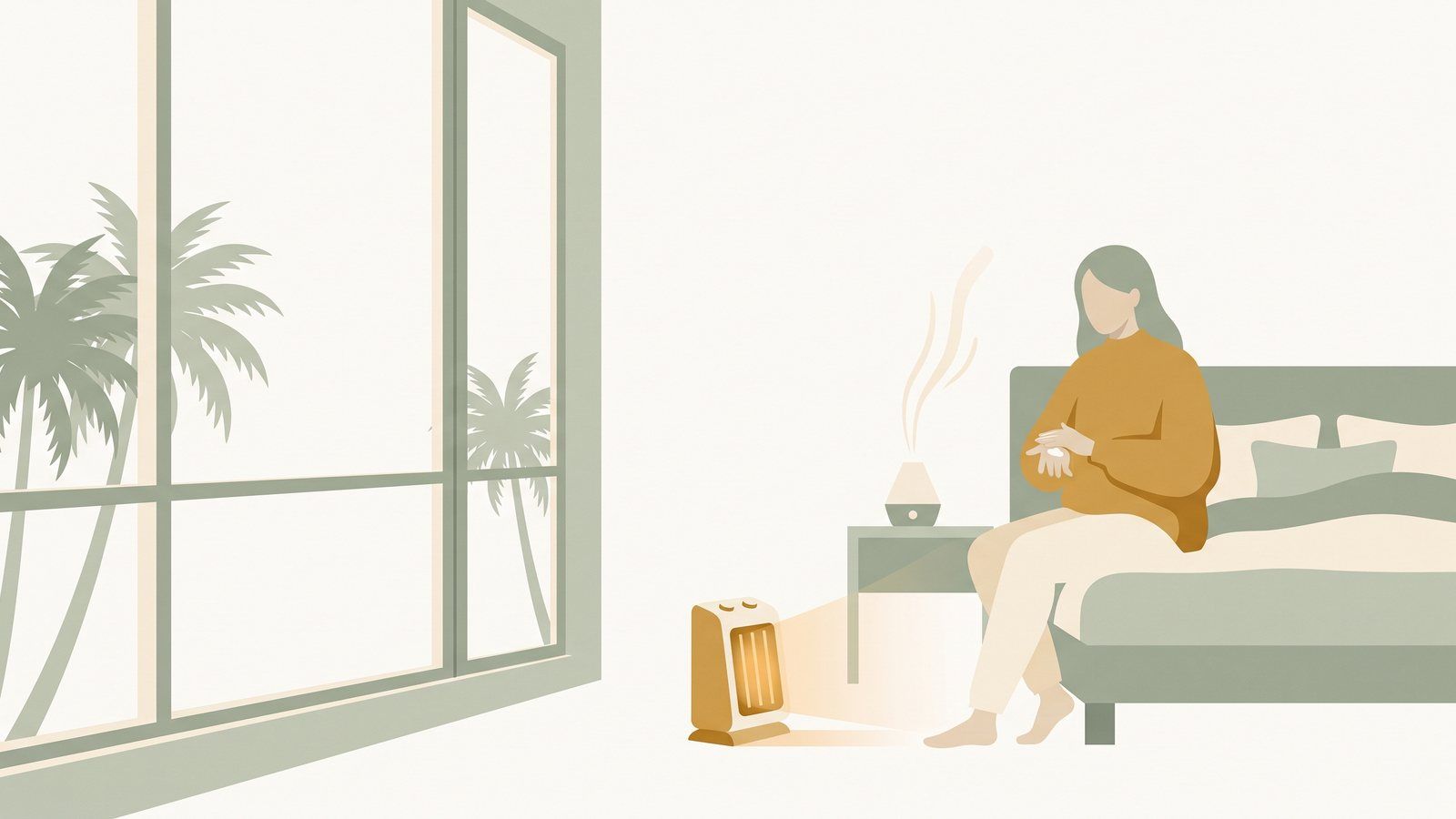
Eczema flares in a Florida winter for the same reason it flares up north: the air gets dry, and so does your skin. Our cold fronts can push the humidity down sharply overnight, and then the heater, longer hot showers, wool sweaters and holiday hand-washing finish the job. The skin barrier in eczema already holds water poorly, so it cracks first. Most of the fix is unglamorous: change the shower, the gloves and the moisturizer routine. Homeopathy, which I offer alongside your doctor's care, is aimed at why your skin reacts this way in the first place.
What a cold front does to your skin
For most of the year the air on the Volusia coast is warm and wet, and the problem is sweat, which I covered in a summer post on humidity and eczema. Between December and February the pattern flips a few times a month. A front comes through, the wind swings to the northwest, and the air that arrives is cool and dry. The overnight low falls into the forties, the humidity can fall by half in a day, and anyone with eczema can feel it in their hands by the next afternoon.
Then the warm, humid air returns a few days later, and the skin has to adjust again. That back-and-forth seems to be harder on some people than a steady cold. Snowbirds arriving from up north often say their skin is better here than at home overall, yet they still notice a sharp flare after each front.
The indoor habits that make it worse
- The heater. Space heaters and heat pumps dry the room air further. A bedroom that sits at 50 percent humidity now can be in the thirties on a cold January night.
- Hot showers. A long hot shower on a chilly morning is the single most common thing clients tell me they changed. Keep it short and lukewarm, and pat dry.
- Wool and holiday clothes. Sweaters that sat in a closet since last year, worn straight against the skin, scratch and trap heat. Wear cotton underneath.
- Hand washing and sanitizer. Cooking for a crowd, wrapping, cleaning, and alcohol gel at every door. Hands take the worst of it.
- Less water. In the cool weather people drink less without noticing, the same thing that shows up in the UTI histories I hear this time of year.
What to change first
- Moisturize within three minutes of every shower or hand wash, while the skin is still damp. In winter, switch from lotion to a thick cream or ointment; lotions are mostly water.
- Put a hygrometer in the bedroom. They cost about ten dollars. If it reads under 40 percent at night, a small humidifier set to bring it to about 50 percent helps many people. Do not push past 55 or 60, or you invite mold and dust mites, both common triggers here.
- Wear gloves for dishes and cleaning, cotton-lined if rubber bothers you.
- Go fragrance-free on soap, detergent and lotion, and skip dryer sheets.
- Keep using what your dermatologist prescribed, exactly as directed.
Where homeopathy fits in a winter flare
The steps above treat the weather. A classical homeopath is asking a different question: why your skin, and not your neighbor's, reacts this way every year. Eczema that worsens in winter is itself a useful piece of information. Some remedies are traditionally associated with exactly that pattern. Petroleum, for example, is the classic picture of deep cracks on fingertips and knuckles that bleed in winter and ease in summer. Graphites fits thick, cracked skin that oozes a sticky fluid. But the remedy is chosen for the whole person, including sleep, digestion, temperature, mood and history, not for the patch on your hands.
I will be honest about two things. First, the research evidence for homeopathy in eczema is limited, and the American Academy of Dermatology advises talking with your doctor before using homeopathic products. Second, chronic skin conditions are slow to shift. First changes, when they come, usually show over a couple of months, and real settling is judged over many months. The eczema service page explains how I work and how follow-ups are spaced, and there are local details on the Ormond Beach eczema page.
Signs that need a doctor
See a physician promptly for honey-colored crusting, pus, spreading redness and warmth, or a fever with a flare; eczema skin infects easily. Clusters of small punched-out sores with fever can be a herpes infection on eczema skin, called eczema herpeticum, and need care the same day.
A good place to begin is that ten-dollar hygrometer. The number on it after the next cold front will tell you more than any product label.
Questions people ask
Related reading
Talk with a homeopath in Ormond Beach
Francine Kanter, CCH, RsHom(NA), meets with clients by phone or video and mails remedies to your door. Serving Ormond Beach, Daytona Beach, DeLand, Palm Coast, Port Orange, and all of Florida.
Homeopathy is a complementary approach that works alongside your conventional medical care. Francine Kanter is a board-certified classical homeopath, not a medical doctor. This article is educational and is not a substitute for diagnosis or treatment by your physician.