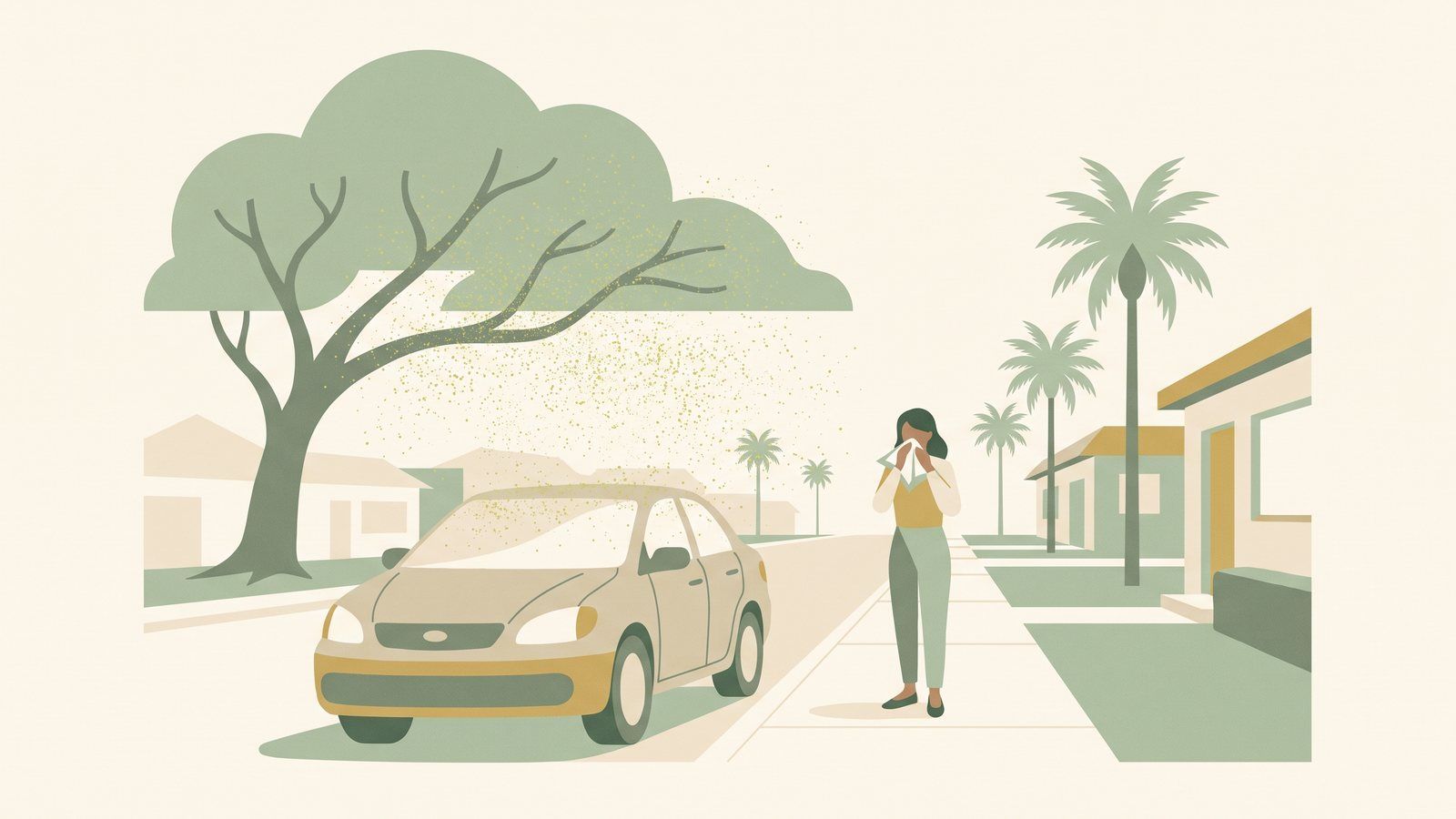
Allergies are bad in Ormond Beach in winter because the trees here pollinate early. Live oak, cedar, pine and bayberry release pollen from roughly January into March, and the humidity keeps mold spores active in every month of the year. People who move here expecting a break from allergies in February are often caught off guard.
The yellow dust on your car is oak pollen
By the middle of February the cars parked along Granada Boulevard wear a fine yellow-green coat every morning. Most of that is live oak. The oaks along the Scenic Loop and in the older neighborhoods near the river drop pollen for weeks, and a dry breeze off the Tomoka River carries it well past the tree line.
Oak gets the blame, but it has company. In northeast and central Florida several trees overlap in the same window:
- Live oak and laurel oak. The heaviest producers, usually peaking in February and March.
- Cedar and juniper. Some of the earliest pollen of the year, often starting in December or January.
- Pine. The coarse yellow pollen that collects in puddles and gutters. The grains are large and fewer people react to them, but the sheer volume irritates eyes and noses.
- Bayberry (wax myrtle). A common hedge and wild shrub that many newcomers have never been exposed to before.
Up north these trees pollinate in April or May. Here the season runs two or three months ahead, which is why a "spring" allergy shows up in the middle of what the calendar still calls winter.
Mold does not take the winter off
Northern winters freeze mold into dormancy. Ormond Beach winters do not. Daytime temperatures in the 60s and 70s, humidity that averages above 60 percent even in the driest months, and ground that stays damp under the oak canopy keep outdoor spores in the air through January and February. Indoors, the air conditioning may be off for a few weeks, so the drying it provides for the other nine months of the year is gone too. Closets and bathrooms in beachside condos get noticeably muskier in the cool months, and for a lot of people the winter problem is two allergens stacked on top of each other: tree pollen outside and mold inside.
Why snowbirds and new residents get hit hardest
Seasonal residents arrive in November or December, just as cedar starts, and stay through the peak of oak. Many have never been sensitized to live oak or bayberry, and the first winter or two can be a surprise. Full-time residents who moved from Ohio or New Jersey tell me the same story: they came here partly to escape allergies and found a longer season instead. Itchy eyes, sneezing in bursts first thing in the morning, a nose that runs clear all day and blocks at night, and a foggy tiredness that lifts on rainy days when the count drops.
How a classical homeopath looks at winter allergies
Conventional allergy care asks what you are allergic to. A classical homeopath asks how you, specifically, react, and the remedy is matched to that reaction rather than to the pollen.
So I want the details. Do your eyes burn or just water? Is the discharge bland, or does it make your upper lip raw? Are you worse outdoors or in a warm room? Restless with it, or wiped out? Do the symptoms arrive at a particular hour?
Those answers point toward a remedy. Four that come up often in hay-fever pictures:
- Allium cepa. Made from red onion. Streaming, burning nasal discharge with bland tears, worse in a warm room, better in open air.
- Sabadilla. Violent sneezing fits, itching deep in the nose, worse from the smell of flowers.
- Euphrasia. The mirror image of Allium cepa: the eyes take the brunt, with burning tears, while the nose runs bland.
- Arsenicum album. Thin, burning discharge, restlessness, chilliness, and symptoms that tend to be worse after midnight.
Choosing among these is not something to do from a list. The remedy that fits depends on the whole person, including sleep, digestion and temperament, and that is the case-taking of a first consultation. The page on homeopathy for allergies in Ormond Beach explains what to expect locally, and the allergy service page covers the approach in more depth.
Many of the people I work with find that over a season or two their reactions become milder and shorter, and that they need their over-the-counter antihistamines less often. Homeopathy works alongside whatever your physician has you on. Do not stop or reduce a prescribed medication without talking to the prescriber first.
When an allergist or your doctor is the right call
Some symptoms are not hay fever and should not be treated as if they were. Please see a physician, and do not wait for a homeopathy appointment, if you have:
- Wheezing, chest tightness, or shortness of breath, especially in a child or anyone with asthma.
- Facial pain, fever, or thick discolored discharge lasting more than ten days, which may be a sinus infection.
- Swelling of the lips, tongue or throat, or hives spreading quickly. For any difficulty breathing, call 911.
An allergist's testing is also useful when you do not know what you are reacting to, and I welcome those results in a consultation.
Small things that help between now and April
- Shower and wash your hair before bed to keep oak dust off the pillow.
- Run the air conditioning for a few hours a day even when the weather is mild. The filter catches pollen and the coil pulls moisture out of the air.
- Keep the car windows up on the morning drive over the Granada Bridge, when the count is highest.
None of that is treatment. It lowers the load while the trees finish. Oak tapers off by April, then the grasses start, and by late summer ragweed takes over. If your February looks like this every year, that repetition is itself useful information, and it is the first thing I would want to hear about in a consultation. A reaction that arrives with the oaks and leaves with them is a clear pattern to work from.
Questions people ask
Related reading
Talk with a homeopath in Ormond Beach
Francine Kanter, CCH, RsHom(NA), meets with clients by phone or video and mails remedies to your door. Serving Ormond Beach, Daytona Beach, DeLand, Palm Coast, Port Orange, and all of Florida.
Homeopathy is a complementary approach that works alongside your conventional medical care. Francine Kanter is a board-certified classical homeopath, not a medical doctor. This article is educational and is not a substitute for diagnosis or treatment by your physician.