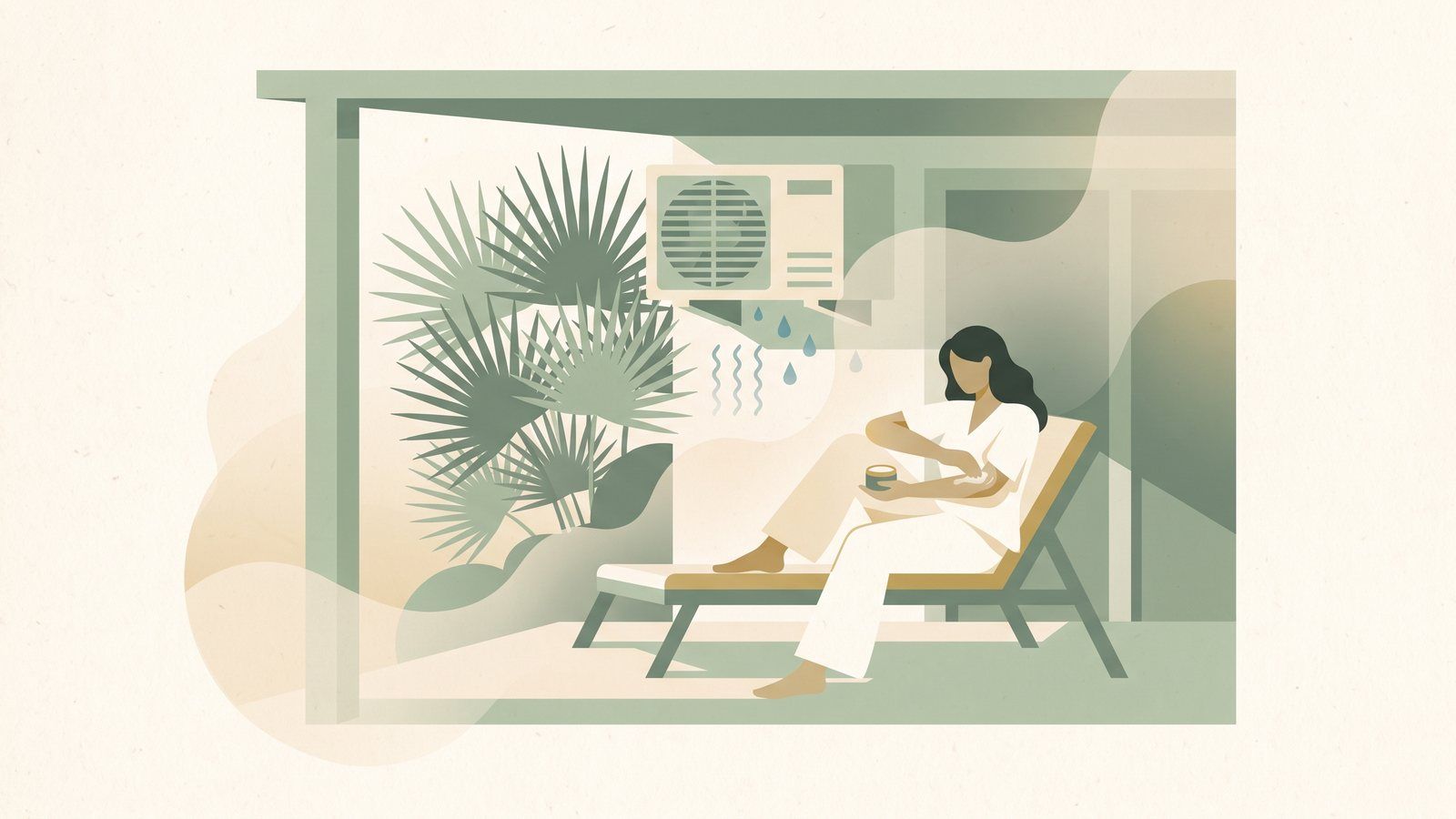
For many people with eczema, Florida humidity does make it worse, mostly because of the sweat and heat that come with it rather than the moisture in the air itself. Others find their skin calmer here than in a dry northern winter, right up until they step inside a condo where the air conditioning has been running since March. Sweat outside and dry conditioned air inside are two separate problems, and most people here have some of each.
Sweat is the trigger, humidity is the delivery
From late May until October the air outside stays thick enough that sweat cannot evaporate. It sits in the elbow creases, behind the knees, along the neck under a collar, and under a bra strap or waistband. Sweat carries salt, and salt on already-inflamed skin burns and itches. The scratching that follows breaks the skin barrier further, and the cycle is under way before you have finished the walk from the parking lot.
People who garden, work outdoors, or take a dog along the river trail in the middle of the day tend to notice this first. Children get it in the diaper area and the folds of the neck. The afternoon storms do not help as much as you would hope; the rain cools things for an hour, then the humidity climbs even higher as the pavement steams.
Air conditioning dries the skin from the inside
The odd part of Florida eczema is that the problem flips the moment you step indoors. Outdoor humidity in July often sits between 70 and 90 percent. A well-running air conditioner brings the indoor air down to 45 or 50 percent, and it runs for roughly nine months of the year. That is a dry climate for your skin to live in most of the day, every day, and the barrier loses water to it steadily.
The result is skin that is sweaty and stinging outside and tight and flaky inside. A lot of people moisturize once in the morning and wonder why it is not enough. In an air-conditioned house the moisturizer needs to go on right after every shower, while the skin is still damp, and again before bed.
Beach, pool, sunscreen and sand
- Chlorine. Pool water strips oils and the residue left on the skin keeps working afterward. Rinse immediately and moisturize.
- Salt water. Mixed. Some find the ocean soothing, others find it stings on any open patch. Either way, rinse off the salt before it dries.
- Sunscreen. Fragrance and certain chemical filters are frequent irritants. Fragrance-free mineral sunscreens (zinc oxide or titanium dioxide) are tolerated by more people, though not by everyone.
- Sand. Friction plus salt plus heat. Sand caught in a wet swimsuit or under a sandal strap will open skin that was almost healed.
Heat rash or eczema?
In summer people often bring me a rash they assume is eczema flaring when it is heat rash, or the other way around. They call for different responses.
| Heat rash | Eczema flare | |
|---|---|---|
| Where | Wherever sweat is trapped: chest, back, under clothing | Your usual places: creases, hands, face, eyelids |
| Looks like | Tiny clear or red bumps, prickly | Dry, rough, thickened patches, often cracked or weeping |
| Timing | Appears within hours of overheating | Builds over days, often after a known trigger |
| Resolves | Within a day or two once cool and dry | Slowly, and returns in the same spots |
What an eczema case covers
The remedy is not a cream. It is taken by mouth, and it is chosen for the person rather than the patch. When I take an eczema case I want to know where the skin is worst and what the eruption looks like, of course, but I also ask about sleep, digestion, heat and cold tolerance, thirst, any history of asthma or hay fever, and what was going on in your life when the skin first turned. The eruption alone rarely decides the remedy. This is what the page on homeopathy for eczema in Ormond Beach means by constitutional care, and the eczema service page goes into how follow-ups work.
Two notes on expectations. First, chronic skin conditions are among the slower things to shift. In my experience the first changes often show within a couple of months, but real settling is measured over many months, not weeks. I usually schedule the first follow-up about a month in, and a chronic case may need several. Second, do not stop a prescribed steroid cream abruptly to "see what the remedy does." Stopping a steroid suddenly can bring a rebound flare worse than the original, and any taper belongs with the prescriber. Homeopathy is added on top of your dermatologist's care.
Signs that need a doctor now
Eczema that has become infected needs medical treatment. See your physician promptly for honey-colored crusting, pus, spreading warmth and redness, or a fever with a flare. If you or your child develop clusters of small punched-out sores with fever and feeling unwell, that can be a herpes infection on eczema skin and it is urgent. Go the same day.
The rest of it, the daily grind of heat and cold and salt, is manageable once you know which side of the door is bothering you.
Questions people ask
Related reading
Talk with a homeopath in Ormond Beach
Francine Kanter, CCH, RsHom(NA), meets with clients by phone or video and mails remedies to your door. Serving Ormond Beach, Daytona Beach, DeLand, Palm Coast, Port Orange, and all of Florida.
Homeopathy is a complementary approach that works alongside your conventional medical care. Francine Kanter is a board-certified classical homeopath, not a medical doctor. This article is educational and is not a substitute for diagnosis or treatment by your physician.