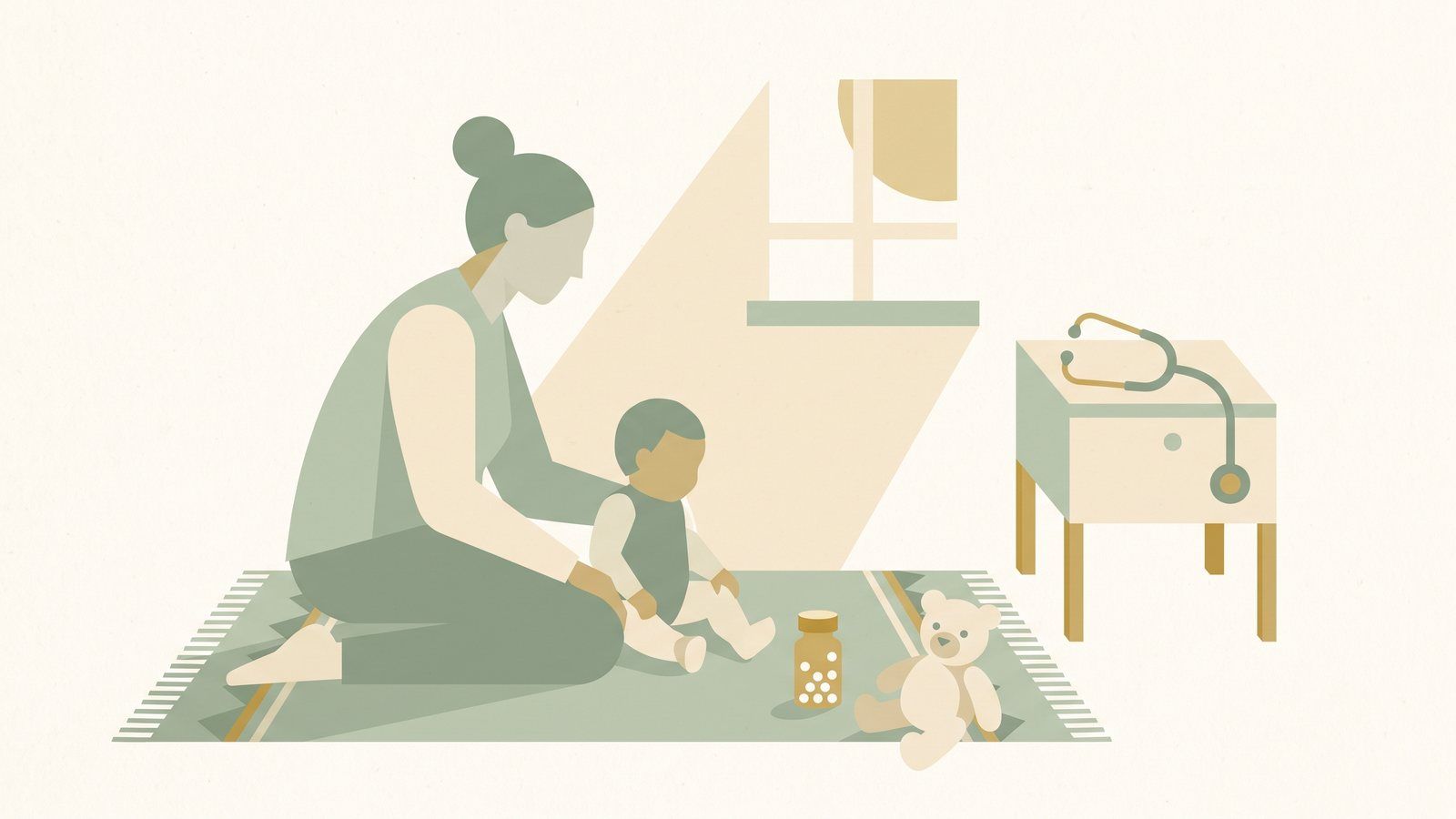
Homeopathic remedies from reputable manufacturers are highly diluted and, in my experience over thirty years, generally well tolerated by children, including infants. Two qualifications belong in the same breath: the FDA does not approve homeopathic products, and homeopathy is not a substitute for vaccines, for antibiotics when a child has a serious infection, or for emergency care. Your pediatrician stays in charge of your child's medical care, and a homeopath works alongside that care.
Why a diluted remedy is generally well tolerated
A classical homeopathic remedy is made by diluting a source substance in steps, with vigorous shaking between each step. By the time a remedy reaches a common potency such as 30C, there is no measurable amount of the original material left in the pellet. That is the reason these remedies rarely cause the kinds of side effects parents worry about with medicines: there is nothing in the pellet to interact with a prescription, upset a stomach, or build up in a small body.
The practical risk with a homeopathic product is almost never the dilution itself. It is what else is in the bottle, how carefully it was made, and whether the label tells the truth. The FDA's history with teething tablets is the case in point.
The FDA, belladonna, and the teething tablets
In 2016 and again in 2017 the FDA warned parents about homeopathic teething tablets and gels containing belladonna. Its laboratory testing found inconsistent, and in some cases far higher than labeled, amounts of belladonna in products that were supposed to be highly diluted, and the agency had received reports of seizures and other serious symptoms in infants who had been given them. The products were pulled from the market.
I bring this up in every conversation with a parent because it is the honest counterweight to "diluted means harmless." A remedy is only as safe as its manufacturing. The FDA also states that homeopathic drug products are not FDA-approved for any use, so no one is checking each batch the way they would check a prescription drug.
What that means in practice:
- Buy from established homeopathic pharmacies. The ones that have made single remedies for decades and follow the Homeopathic Pharmacopoeia of the United States. Avoid products marketed for infants that do not state the exact dilution of each ingredient.
- Be wary of combination products for "teething," "colic," or "sleep." These mix several substances, are not chosen for your child, and were at the center of the belladonna problem.
- Work with a certified practitioner. A board-certified classical homeopath selects one remedy at a time, from a known pharmacy, and knows what to watch for afterward.
What homeopathy is not for
The following are not judgment calls. Homeopathy does not replace:
- Vaccines. There is no homeopathic substitute for the childhood immunization schedule. Anyone who tells you otherwise is not practicing classical homeopathy responsibly.
- Antibiotics for a serious infection. Strep throat, pneumonia, a urinary tract infection in a baby, an ear infection that the pediatrician wants treated. Take the antibiotic.
- Emergency care. Trouble breathing, a seizure, a bad allergic reaction, a serious fall. Call 911.
- Diagnosis. I am not a medical doctor. If you do not know what is wrong with your child, the pediatrician finds out first, and then we talk.
For babies specifically, please see the pediatrician the same day, or go to the emergency room, for any fever in an infant under three months, fewer wet diapers than usual or no tears when crying, unusual limpness or sleepiness, a rash that does not fade when you press a glass against it, a stiff neck, or any change in breathing. None of those wait for a homeopathy appointment.
What parents in my practice usually bring
With those limits stated, the everyday reality is quieter. Most of the children I see are not sick in a way that alarms anyone. They have a chronic, nagging pattern that the pediatrician has already seen and that conventional care manages without quite settling.
Eczema. The most common reason a parent calls. A toddler with cracked elbow creases and a bedtime scratching routine, usually already on a steroid cream. My approach to homeopathy for eczema is constitutional: I am trying to match the child as a whole, including sleep, digestion, temperament and any history of asthma or hay fever in the family, rather than treating the skin from the outside.
Allergies. A school-age child who spends February through April sneezing under the oaks, or who wheezes every time the neighbor mows. The page on homeopathy for allergies describes how individualized the remedy choice is. A child's allergy picture is often clearer than an adult's, because children tend to show what they feel.
Constipation. Sometimes a physical pattern, sometimes something more tangled. One published case on this site, a little boy's fear of constipation, describes a shy six-year-old who would hold his stool for days out of fear. The remedy in that case was chosen for the whole child, his fearfulness and restlessness and frequent chest colds included, not for the bowel alone.
Sleep. Night terrors, a baby who startles awake at the same hour, a child who cannot settle without a parent in the room. Sleep is often the first thing that changes when a remedy fits well, and it is usually the first thing a parent notices.
How a child's consultation works
Everything is by phone or video, and the parent does most of the talking. I ask about the pregnancy and birth, feeding, milestones, illnesses, and the pattern of the current complaint: when it started, what makes it better or worse, what the child is like when it flares. I also ask about temperament. Is this a child who wants to be held or one who pushes you away when upset? Does she run hot at night and kick the covers off, or burrow? Does he crave salt, or sweets, or ice?
Those details are what point toward one remedy rather than another. On video I can watch the child play, notice the complexion, and see how a toddler responds to a parent's voice, which tells me more than a list of symptoms typed into a form.
After the consultation I select a single remedy and mail it to you. For a baby, a pellet dissolves in a spoon of water. For an older child, the pellets melt under the tongue and taste faintly sweet. Then we wait and watch, usually four to six weeks, before the first follow-up. I do not stack remedies.
The practical side
A good children's case cannot be rushed, so the first consultation is a long conversation. Fees are listed on the virtual consultation page, along with a description of how a phone or video appointment runs.
A few rules I ask every parent to follow:
- Tell your pediatrician you are working with a homeopath. Better that they know and disagree than not know at all.
- Keep giving prescribed medication as directed. Any change goes through the prescriber.
- Do not treat a fever in an infant yourself. Call the pediatrician.
- Tell me about every vitamin drop, probiotic and over-the-counter product the child takes, including the ones that seem too minor to mention.
- Store remedies out of reach.
That last one is not a formality. The remedy arrives in the mail in a small tube, the pellets look like tiny sugar beads, and a toddler would happily eat every one. Keep it on the high shelf with the rest of the medicines.
Questions people ask
Related reading
Talk with a homeopath in Ormond Beach
Francine Kanter, CCH, RsHom(NA), meets with clients by phone or video and mails remedies to your door. Serving Ormond Beach, Daytona Beach, DeLand, Palm Coast, Port Orange, and all of Florida.
Homeopathy is a complementary approach that works alongside your conventional medical care. Francine Kanter is a board-certified classical homeopath, not a medical doctor. This article is educational and is not a substitute for diagnosis or treatment by your physician.